


SC Freiburg

Tonight Sports Club Freiburg will take to the pitch at Tüpraş Stadium in Istanbul to play in their first ever European final - for a chance to win the Europa League Trohpy. England's historic Aston Villa stand in their way.
Freiburg have been on supreme form in Europe this season as they're progressed to the final, making short of work of Belgium's Genk (5-2), Spain's Celta Vigo (6-1) and Portugal's Braga (4-3).
But who are they? They aren't the most famous of German teams - they only made it into the top flight of German football in 1994 (exactly 100 years after the original club was formed). They’ve had some highs, finishing 3rd in 1996.
During that time they earned the nickname Brazilians of Breisgau (Freiburg's full name being "Freiburg im Breisagau"2) for their free flowing and attacking style of football.
Since then they’ve apent then last 30 years being the bounce back kings - being relegated a handful of times but coning right back up at the first attempt - they’ve also played a good number of UEFA and Europa League cup games in that time too.
So that's the club - let's #GetTheBadgeIn and dog a bit deeper into who Freiburg really are.
On their badge - in their black and white colours - you can clearly see their initials - SCF. A reminder that in Europe most teams called Sporting Club rather than Football Club usually are a larger organisation that field teams in other sports like basketball too. Although in this instance I can't see any additional teams beyond their woman's team. Someone correct me if im wrong.
The most striking thing about the badge is the stylised griffen's head on the top half of the oval. So the question is... why the griffen?
The griffen is taken from the Baden-Württemberg coat of arms - the "Bundesland" (State) in which Freiburg sits. The griffen is the left hand supporter of the shield.
It is also used in other local symbols like the nearby Ganter brewry - which actually has a stylised griffen head that is almost identical to the one used on the Freiburg badge.
So where actually is Freiburg?

It is nestled in the bottom South-West corner of Germany near the French and Swiss borders. It's name goes back to its founding when it was formed to be a "Free Town" (Frei - Burg). It was in the perfect place for trade - being at the meeting of several rivers and roads that came up from the Mediterranean and those that come down from the North Sea - it also provides great access to the Black Forest which today brings in North Face clad tourists with thermo flasks but used to provide timber and furs for trade. It also had one other secret ingredient- local silver mines. So much silver was dug out of the local quarreys that the town soon became one of the richest in Europe and boasted its own mint from which it made coins. This led to the building of the iconic red merchant hall in the town centre which is still there today.
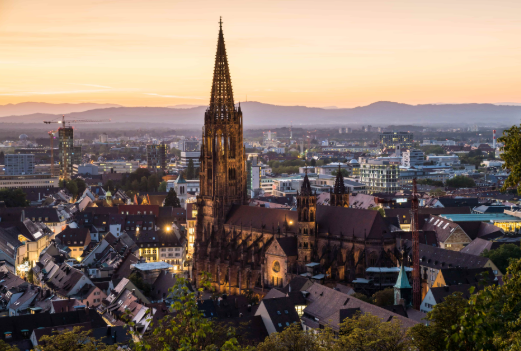
All this success attracted the interests of the Gods - or just the one God I suppose - and the city erected the incredible Freiburg Minster cathedral which dominates the city skyline and oozes gothic beauty. It then was further boosted when it founded its university which, starting in 1457, is one of Germany's oldest.
The residents of Freiburg have always been a resourceful bunch - despite the city's great strategic location it suffered from a deep water table (e.g. only really deep wells would provide water). To solve this problem, starting as far back as 1100, locals began channeling small gulleys into their road network which channeled water from the Dreisam river into the town. This unique irrigation system, known as the Freiburg Bächle, still exist today and are a tourist draw. Legend has it if you accidently stand in one you are destined to marry a local. Which sounds like quite a burden for the locals to have to deal with to be honest.

The city today still retains its medieval beauty despite having experienced several wars over the centuries as Asutrian Habsburgs, the French - and more recently RAF Bomber Command - did their best to level the place. Fortunately it has been rebuilt to its old designs and plans (which is where Britain went wrong - we rebuilt on the cheap with giant 50s and 60s style concrete monstrosities packed with abestos - Germany decided to rebuild its medieval charm).
Beginning the 1990s the city adopted strict sustainability criteria for all new buildings and has become a centre of the local solar ans green economices with lots of companies and international organisations based withij the city limits.
So there we have it. The good men and women of Freiburg. From silvermines to irrigated road networks to medieval gothic beauty to solar panels and green tech - all in just a thousand years.
And tonight - the silverminers of Free Town hope to bring home some footballing silverware too.


Comments