


FSV Mainz 05

Mainz, Germany. Located on the west bank of the Rhine River – Northern Europe’s most important trade route. It sits opposite Wiesbaden and close to Frankfurt, making it an important transport hub for the wider region.
Its football team, FSV Mainz 05 (founded in 1905 – hence the 05, as many German teams do), has in recent decades cemented itself in the Bundesliga without really challenging for the top positions. A few Europa League forays and a quarter-final appearance in the UEFA Conference League this season show they are currently in fine form.

Team legend is undoubtedly a certain Jürgen Klopp, who made 325 appearances for the club as a player before managing them from 2001 to 2008, getting them promoted in that time to the Bundesliga. The lessons he learned there were enough to allow him to take both Borussia Dortmund and then Liverpool to incredible trophy hauls during his time with them. Just over a year from Klopp’s departure, the club appointed a new manager – a Mr Thomas Tuchel. Again, Mainz was the launchpad for a stellar managerial career – Tuchel went from there to Borussia Dortmund, to PSG, to Chelsea, to Bayern Munich – and, as of 2025, the England national team. What is in the water at Mainz?
So that’s the club. What of the city and the badge? The badge itself is fairly straightforward, as many German teams’ badges are – simple, effective, stylistic, and linked, in a subtle way, to the ancient history of the city as a centre of religious authority. So let’s well and truly #GetTheBadgeIn and see what we can discover.
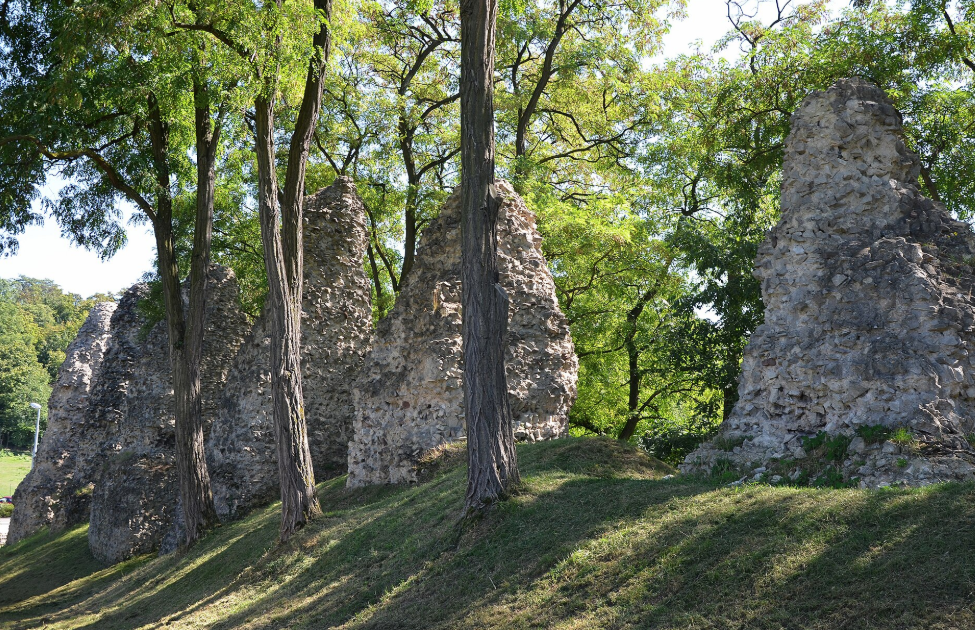
Let’s go right back 2,000 years ago, because there’s a lot of cracking history to cover here.
First up, the Romans. They discovered a small settlement of Celtic tribes along the Rhine River and, realising it was a great spot from which to dominate the trade and security of the area, ousted them and built themselves a forward operating base of sorts. They founded Mogontiacum, as they called it, and began stationing legions there and building roads, baths, temples, and a theatre, which turned the area into a large urban centre. Today the ruins of this Roman city are everywhere around the city: From the aqueduct that brought freshwater into the city (pictured) to the theatre that entertained its people and dozens of archways, gates, temples and baths - all preserved within the city limits.
But it was to be centuries later that this town was to become one of the most important in Western Christendom. Following the fall of the Roman Empire, central Europe splintered into rival regions and city-states – all of whom shared a collective sense of past and roots in that old Roman Empire. In 800 AD, the Pope crowned the great conqueror Charlemagne as a new ‘Emperor’ of what was left of the Roman Empire – which, as we have seen, became known as the ‘Holy Roman Empire’. However, it couldn’t have been much more different from the old Roman Empire – it was decentralised and the Emperor was elected by local princes.

And this is where Mainz comes into it. Mainz, as an important trading and military centre, came to host an archbishopric inside the mighty Mainz Cathedral. The Archbishop was one of the ‘Electors’ of the Holy Roman Emperor.

It is from this position that the city derives its coat of arms – a symbol that often appears on the FSV Mainz home shirts (it is on the back of the 25–26 shirt) and is known as the Wheel of Mainz. Its origins are argued over, but the most popular theory, as told by the Brothers Grimm – two German brothers who collected folklore and published it during the 18th and 19th centuries – is that it links back to Archbishop Willigis, who took up the role in 975. Willigis had an unlikely background; he came from a poor family of wheelwrights, and his opponents looked down on his lowly birth and mocked him. Not one to be put off, Willigis decided to own it and adopted the wheel symbol as his coat of arms.
The round ‘wheel’ formed by the stylised M in the FSV Mainz badge today looks remarkably like the wheel symbol itself, and while I cannot find any source directly linking the two, it is a happy coincidence if not intentional.

The next section of the city’s history can be told through the very odd-looking youth team club mascot – Johannes the Clown.
This mascot represents two things at once – one of Europe’s greatest technological innovations and a long history of partying.
In order, then, let’s start with the innovation: the printing press. Anyone who knows a thing or two about history will know the name of the Gutenberg printing press. It is credited with helping to spark both the Renaissance and the Protestant Reformation that spread across Germany and then, thanks to Henry VIII, England.

The printing press was remarkable in that its use of movable type allowed books and pamphlets to be quickly created and spread. With them went ideas, controversies, and even new religions. It sounds fairly unremarkable, but it suddenly reduced the cost of reading materials so that anybody could get hold of them (most people could not read – why learn a difficult skill that you could only use if you had the money for books?). It also challenged the power of the Church. Up until then, books had been painstakingly handwritten by monks in monasteries across the continent. And who controlled what books were copied out? The Church, of course – they decided what could be written. The printing press democratised knowledge. That wooden machine, with a few simple metal pieces of type, ushered in a political and technological earthquake that put Europe on course to become the dominant power for centuries afterwards.
The inventor? Johannes Gutenberg. That slightly creepy mascot is named after the father of printing.

…but why call him a clown? This is where Mainz’s culture and history of carnivals comes into play. The Rhineland region is home to a long-standing tradition of wild carnivals that culminate on the first day of Lent. In Mainz itself, the event involved the leadership of the city – even the Elector. During these celebrations, roles at court were rearranged at random. In 1664, the prince-elector drew the role of cabinetmaker; in 1668, he was cup-bearer and had to serve all guests. This custom was called the “Mainzer Königreich” (Mainz kingdom). Locals would wear colourful costumes and masks to hide their identity, which also gave them cover for acts of extreme behaviour.

Mainz has continued this tradition with the Mainzer Fastnacht, which begins every 11 November at 11:11am and lasts until the spring, with various parades throughout. It involves floats, elaborate costumes, and characters with massive heads representing local German folk stories. The parades head to the main square and the ‘Festival Fountain’, an intricate sculpture featuring more than 200 bronze figures, including (are you ready?): Father Rhine, a monk, a fool with his symbols, Harlequin, and a man with a plank before his head, as well as a cat, Till Eulenspiegel, Hanswurst, and the city goddess Moguntia, money-washers, vagrants, exaggerated heads, jesters, and jugglers – alongside vine tendrils and famous local foods such as bread, sausage, and wine. It is quite the statue.

Revellers in the parades create impressive – and slightly unsettling – papier-mâché heads (known as Schwellkopp characters) based on famous folklore. In recent years, the football club has picked one of these characters as the basis of their third ‘Carnival’ shirts, which sell out almost instantly. This year it is based on a character called Lisbetche, traditionally depicted wearing a pink feather boa and patterned blouse. What better focus for a football shirt?
So there you have it.
A very simple badge design that tells the story of Roman forts, humble tradesmen rising to become Electors of emperors, a technology that transformed the world and launched the modern era – and a thousand-year-old tradition of wild parties and celebrations of folklore. Not to mention two of the most successful football managers of the modern era.
I bloody love FSV Mainz 05.
Enjoyed discovering the history behind this badge? This story also appears in Wolsey Academy's Renaissance History curriculum, where students explore the people, places, ideas and events that shaped the Renaissance through enquiry-based lessons, projects and historical investigations.
Teachers can browse the full collection at www.wolseyacademy.com/shop and receive 50% off any lesson bundle using the exclusive #GetTheBadgeIn code GTBI50.


Comments