


Panama

They've met before, but tonight England take on Panama once again, this time in the 2026 FIFA World Cup. Before a ball is kicked, though, I spotted their FA's beautifully designed crest and felt compelled to do some due diligence on the men from Central America. So let's #GetTheBadgeIn and see what we can discover...
This badge only arrived in 2024, so tonight will be the first time it has taken to the field against England. And, obviously, what immediately grabs your attention - because it is exceptionally cool - is the enormous bird spreading its wings around the shield at its centre.
This is the Harpy Eagle - Panama's national bird, one of the largest and most powerful birds of prey on Earth. Unlike most of its cousins, it doesn't spend its days soaring over open plains looking for unsuspecting mammals to dive-bomb. Instead, it inhabits the dense tropical rainforests of Central and South America, with some of its strongest remaining populations living in Panama's vast Darién rainforest. Flying through the thick jungle requires a very different set of skills. Rather than possessing the long, narrow wings of an eagle built for gliding, the Harpy Eagle has relatively short, broad wings that allow it to weave effortlessly between towering trees in pursuit of prey.
And what prey they hunt.

While most eagles survive on rabbits or rodents, Harpy Eagles regularly hunt monkeys, sloths, iguanas and other surprisingly large mammals. Their talons can grow to over 12 centimetres long - larger than the claws of a grizzly bear - allowing them to snatch prey weighing almost as much as the eagle itself. Sitting right at the top of the rainforest food chain, these bad boys really are the kings of the jungle. When staring straight down the barrel of the camera they also resemble something out of Star Trek. They're creepy frigging things.
Despite being a new badge, the design team have done a fantastic job of packing it with meaning - something I very much approve of.
The ten wing feathers, for example, represent Panama's ten provinces, while the four crest feathers rising from the eagle's head symbolise the four key stages in the federation's journey towards creating its new identity. (As this is the federation's fourth badge, I'm assuming that's what they mean.)
Nestled in the eagle's chest sits a shield that pays tribute to Panama's footballing past. Rather than designing something entirely new, the federation looked back to its historic 1977 crest, incorporating its shape into the modern design. Within it are the familiar red, white and blue quarters of the Panamanian flag.
And those colours tell a fascinating story of their own.

When Panama declared its independence from Colombia in 1903, the new nation wanted a flag that would represent unity rather than division. The blue represents the Conservative Party, while the red represents the Liberal Party - two political movements that had spent years locked in bitter rivalry across Colombia. Indeed, they fought tooth and nail against each other between 1899 and 1902 in what became known as the Thousand Days' War (which also featured a very high number of child soldiers - see image). Separating them is white, symbolising the hope for peace and harmony between the two sides as the young republic forged its own identity.
Officially, the blue star represents purity and honesty in public life, while the red star symbolises authority and the rule of law. It's all a little idealistic for my liking... but I suppose it shows that even in the early 1900s some designers liked to dream big. It is, therefore, a wonderfully optimistic flag - one that doesn't celebrate military victories or ancient dynasties, but instead reflects the values that Panama hoped would define its new future away from their Colombian big brothers.
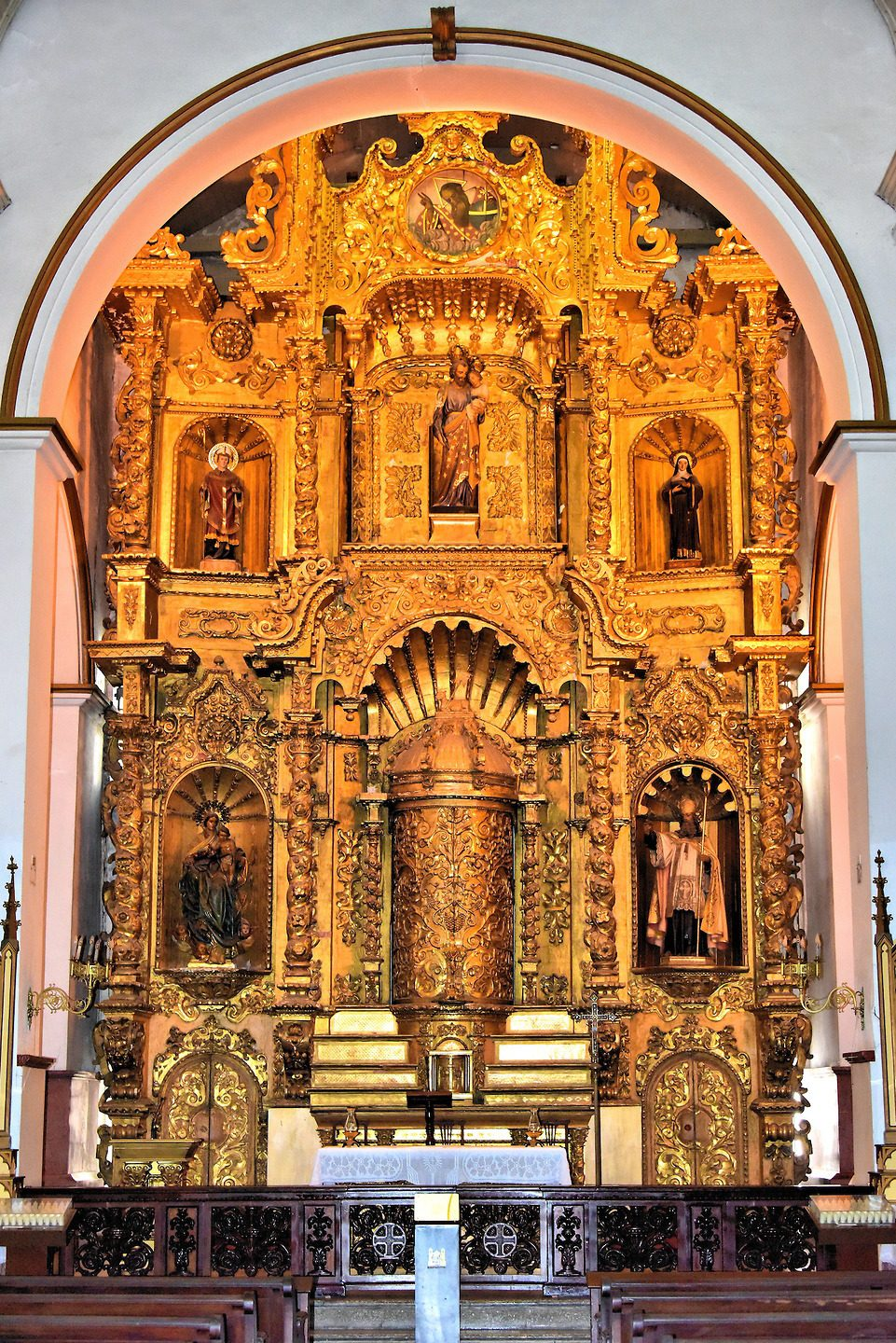
The gold border surrounding the crest takes its inspiration from the famous Golden Altar inside the Church of San José in Panama City. According to local tradition, when the pirate Henry Morgan attacked the city in 1671, priests painted the altar black to disguise its value and prevent it from being looted.
Morgan was a Welshman who took it upon himself to help the English in their war against Spain by looting Panama City. And he did so with gusto, burning much of the city to the ground and stealing just about everything of value (minus the altar). Upon returning to the Caribbean, however, he discovered that England had signed a peace treaty with Spain before his attack. Claiming he had never received the news, he was arrested for attacking what had, by then, become a friendly nation.
On returning to England, the prisoner was pardoned by King Charles II and, in one of history's more remarkable career progressions, was knighted and appointed Lieutenant Governor of Jamaica for his troubles. Lad.
The altar went on to become one of Panama's greatest national treasures, and its golden outline on the badge serves as a reminder of the country's resilience.
In a region dominated by Mexico, the United States and Costa Rica, Panama often found itself on the outside looking in. The national side came painfully close to reaching the World Cup on several occasions, only to fall at the final hurdle.
Then came 10 October 2017.
With just two minutes remaining against Costa Rica, the scores were level. Panama needed a winner to qualify for the FIFA World Cup for the very first time. Up stepped captain Román Torres. His scrambled finish sparked scenes unlike anything the country had ever witnessed. The final whistle triggered a nationwide celebration. Schools closed. Businesses shut their doors. The President declared the following day a national holiday. For a country of just over four million people, it was one of the greatest sporting moments in its history.
Their reward was a place at the 2018 World Cup in Russia, where fate handed them a daunting group featuring Belgium, Tunisia... and England.

The 6–1 defeat to England was, admittedly, a little bruising. But the locals don't really remember the scoreline. They do, however, remember the 78th minute, when veteran defender Felipe Baloy bundled home Panama's first-ever World Cup goal. His celebration became one of the iconic images of the tournament. Panama may have been well beaten, but for their supporters, history had been made.
After narrowly missing out on the 2022 World Cup, Panama have returned to the biggest stage once again in 2026. Tonight they meet England once more.
And yet, as fascinating as Panama's football story is, it still isn't the country's greatest contribution to the world.
For that, we have to leave the football pitch altogether.
Few places on Earth have shaped history quite like Panama - and, in many ways, shaped the modern world.
The country sits on a narrow strip of land, known as an isthmus, linking North and South America. At its narrowest point, the Atlantic and Pacific Oceans are separated by barely 80 kilometres. For centuries, explorers, merchants and empires looked at this sliver of land and asked the same question - where's the bloody shortcut?
Without a passage through, ships travelling between the east and west coasts of the Americas had little choice but to make the hazardous journey around Cape Horn at the southern tip of South America. It added thousands of kilometres to every voyage, increasing costs, delaying trade and exposing ships to some of the roughest seas on the planet.

The first serious attempt to solve the problem came from the French in the 1880s. Fresh from the success of the Suez Canal, Ferdinand de Lesseps believed Panama would simply be another triumph of engineering. He was spectacularly wrong.
Unlike the flat deserts of Egypt, Panama was a wall of dense rainforest, steep hills, torrential rain and unstable ground. Workers battled landslides, flooding and suffocating humidity. Even worse were the diseases. Mosquitoes carrying yellow fever and malaria swept through the camps, killing thousands of labourers before anyone understood how the illnesses spread. The project collapsed in financial ruin and tragedy.
However, sitting in Washington was one of the most extraordinary American presidents ever to hold office: Theodore "Teddy" Roosevelt. (If you don't know much about him - honestly, Google him. What a bloke.) Roosevelt dreamed of turning the United States into a global power and knew that was rather difficult when its Atlantic and Pacific coastlines were effectively worlds apart.
He approached Colombia, outlining America's new engineering techniques, its growing understanding of mosquito-borne diseases and, perhaps most importantly, the fistfuls of dollars it was prepared to throw at the project. Colombia, however, was unimpressed and rejected the proposal.
It was then that Roosevelt suddenly discovered a great enthusiasm for those in Panama calling for independence. By remarkable coincidence, Panama declared independence shortly afterwards. By another remarkable coincidence, the US Navy appeared almost immediately to ensure Colombian forces were unable to put the rebellion down. Historians can debate quite how coincidental all of that really was...

Construction resumed in 1904 and, ten years later, in 1914, the Panama Canal finally opened.
It was one of the greatest engineering achievements in human history.
The impact of the Panama Canal is almost impossible to overstate.
A journey that once took weeks could suddenly be completed in less than a day. Instead of battling the treacherous seas around Cape Horn, ships could simply pass through the heart of Panama, linking the Atlantic and Pacific Oceans with a transit of little more than 80 kilometres. It revolutionised global shipping, transformed international trade and cemented Panama's place as one of the world's most strategically important countries.
Even today, around five per cent of global maritime trade passes through the canal each year. Everything from cars and electronics to grain, liquefied natural gas and shipping containers travels through its locks. When drought lowers the water level or maintenance restricts traffic, the effects are felt across the globe, with delays and rising costs rippling through international supply chains.
For Panamanians, however, the canal is far more than an engineering marvel. It is a source of national identity, immense pride... and a healthy chunk of the country's income. The national football team's nickname, Los Canaleros – The Canal Men – is a direct tribute to the waterway that placed Panama at the crossroads of the world.
So, as England line up against Panama tonight, it's worth remembering that their opponents represent far more than a football team. From one of the world's most fearsome birds of prey, to a flag that symbolises unity after political division, to an engineering project that changed global commerce forever, Panama's story is extraordinary.
Not bad for a bird on a badge.


Comments