


Ajax 'Sea' Away Kit 2025/26

Ajax have had a recent reputation for producing utterly striking and beautiful kits. I suppose, being named after a Greek hero, Ajaz FC have always been looking to stand out.
Their 2025/26 away shirt may quietly be one of the most historically loaded kits in modern football. Many a team has produced a ‘wavy’ kit to indicate their town’s relationship with the sea. But few can boast that their connection to the sea has been as impactful as that of Amsterdam’s.
Because it was from the docks of Amsterdam that the Dutch struck out on an epic journey of discovery, conquest, enrichment – and murder and destruction. It was on those waves that the Dutch turned themselves into a peripheral corner of Europe looking out onto the rough weather of the North Sea- into one of the richest and most influential cities on Earth.
So, let’s dig a bit deeper into this tale and understand what we are truly looking when we see those waves… let’s #GetTheShirtIn for Ajax’s 25/26 Away kit.
At the centre of this story is the Dutch East India Company. The VOC. Or to give it its full Dutch name: Vereenigde Oostindische Compagnie — the United East India Company.

Founded in 1602, the VOC was effectively the world’s first multinational corporation centuries before anybody had even invented the concept. It had private armies, its own navy, overseas colonies, the power to sign treaties and even the legal right to wage war. In many ways it behaved less like a business and more like a country with shareholders. A sort of arrangement that I can image Musk would like to do to the USA into – and Trump is already busy doing.
But the thing that both of those should probably learn, was that it was not just military power that made the VOC so great.
It was systems. Efficiency. Finance. Logistics. Ruthless practicality.
Because the Dutch were not the first ones to the game: The Portuguese and Spanish had opened the great oceanic trade routes first. Portugal had established routes around Africa into India and the Spice Islands while Spain had built vast Catholic empires across the Americas and Pacific. But both powers remained heavily tied to royal monopolies and old aristocratic structures. Their empires were enormous, but slow, bureaucratic and expensive.

The Dutch however, like to do things differently. The Netherlands was heavily Protestant, commercially minded and dominated by wealthy merchants rather than old school clerics and the absolute monarchs you’d find in the warmer climes of Southern Europe. While Spain spent fortunes on imperial wars and religious conflict, the Dutch innovated new methods of banking, shipping, warehousing and investment.
And in so doing – they changed history.
The VOC became the first company in history to launch what is widely considered the world’s first proper Initial Public Offering — an IPO. People could buy shares in the company and then later sell those shares to somebody else on Amsterdam’s growing financial markets. That may sound normal today, but at the time it was revolutionary. Previously investors often had to fund one risky voyage at a time and wait years to see whether a ship returned intact.
This turned out to be the secret for unlocking human ingenuity. Capital was no longer tired up in golden robes and stainglass windows – but was plunged into new inventions and voyages of discovery.
The wheels of the modern world began turning in Amsterdamn. Wealthy merchants who had never even seen Asia could suddenly become rich from spices arriving halfway across the world.

And it was that, spices, especially nutmeg, which became the first cargo. A but like Frabk Herbert’s Dune – He Who Controls The Spice, Controls the Galaxy.
Today nutmeg is deeply unremarkable. You have it in Christmas pudding or sprinkle it on a latte. But in the 1600s it was worth extraordinary sums of money. Europeans believed it could preserve food, improve health and even help fight the plague.
But where did this ‘cure all’ spice come from? – The other side of the world. To be specific – the Banda Islands.

The tiny Banda Islands in modern Indonesia became some of the most valuable places on Earth because they were one of the few locations where nutmeg naturally grew.
Entire fleets sailed halfway around the globe for it. A successful journey to the islands and a return with a hold full of nutmeg could set you up for life.
Wars were fought over it. The local people were massacred over it. Eventually the British took control of them – and then agreed to hand them back but only in exchange for a swampy bit of the North America coast known then as New Amsterdam. The Dutch, thinking this was the deal of the century, agreed.
Today New York is… well. New York.
That slight miscalculation aside the VOC became one of the most powerful organisations on Earth. Amsterdam’s shipyards became essential to this success. The Dutch transformed shipbuilding by using industrial production methods centuries before the Industrial Revolution properly began. Their docks used standardised parts, specialised labour and highly organised construction systems that allowed ships to be built faster and more cheaply than elsewhere in Europe.
Their greatest innovation was the superbly named - fluyt.
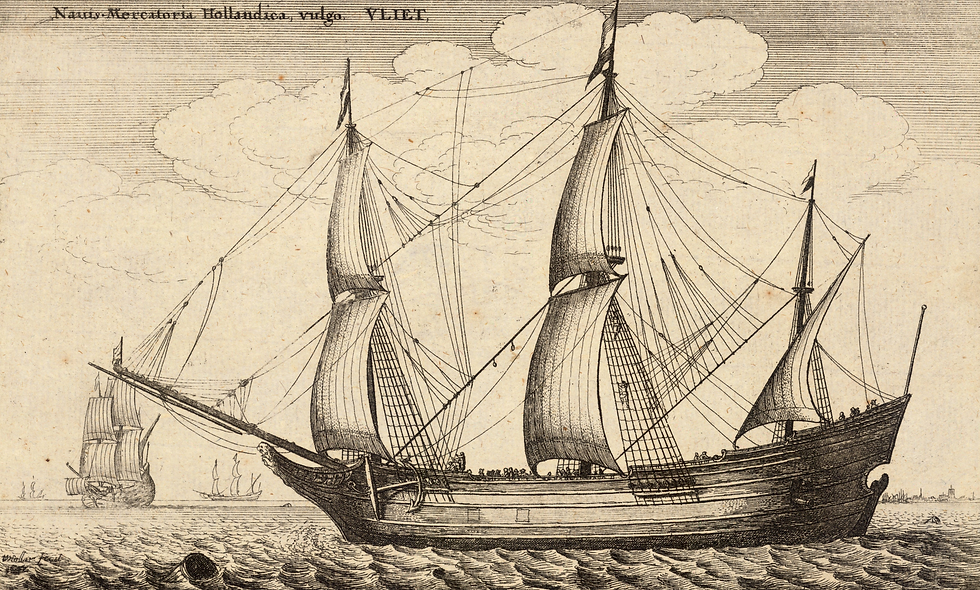
Unlike the giant prestige warships favoured by the Spanish, the fluyt was designed almost entirely around efficiency and cargo capacity. It had wide storage holds, simpler sails and required far smaller crews than traditional vessels. This mattered enormously. Fewer sailors meant lower wages. Larger holds meant more spices and goods could be transported per journey. The Dutch essentially redesigned the cargo ship around profit margins.
And when needed, those ships could still fight.

Dutch maritime power became so formidable that in 1667 they launched the famous Raid on the Medway during a war against England. Dutch forces sailed directly into English waters, attacked Chatham Dockyard, destroyed ships and captured the English flagship Royal Charles. It remains one of the most humiliating defeats in English naval history and demonstrated just how dominant Dutch shipbuilding and naval organisation had become.

The Dutch also benefited from what today would probably be called industrial espionage. For decades Portugal had guarded maps, navigational routes and Asian trading knowledge as state secrets. Then along came Jan Huyghen van Linschoten. After working closely with Portuguese operations in Asia. After an argument with his bosses he packed up and returned to Europe – and mysteriously published a series of detailed maps, routes and sailing information that Portugal had desperately tried to keep hidden. The equivalent of downloading your work places hard drive before moving to a rival.
This information fuelled further investment in more voyages and missions across the world to open up new markets and bring back precious goods.
Which brings us back to Ajax’s shirt. Those waves. Not just the hazy view from an Amsterdam coffee shop.
They represent harbours, cargo ships, canals, finance, shipyards, trade routes, capitalism, empire and maritime innovation. They represent a city whose fortunes literally rose with the tides.
A tale of fortunes, fluyts and football.


Comments