


Palmero FC

Ancient city, from a culturally rich and unique island with a famous club that today is backed by one of the richest footballing stables in the world. Sounds like a winning mix right? Let's #GetTheBadgeIn and see what we can discover as we peek into the eagles' nest of Palermo.
First things first - the team - they are currently in Serie B but have competed in Serie A and been in the UEFA Cup 5 times. They have tended to bounce between the two top leagues, having won the second-tier title on 5 occasions. While a historic - and iconic - team, they have not had the success of other Italian clubs like your Milans, Napolis or that other "Le Aquile" team based in Rome.

Before we even dig into the wider history of Palermo and Sicily as a region - and the origin of their eagle - we need to appreciate the fantastic story behind the club’s own history.
Founded in 1900 by English sailors and shipyard workers in Sicily, they named the team Anglo Palermitan Athletic and Football Club in 1900.They initially played in white and red shirts as a homage to the Union Flag and changed their name to Palermo Football Club a few years later.
In 2025 Man City played them in a one-off Anglo Palermitan Trophy to commemorate the 125th anniversary of the Sicilian club’s first ever fixture - played against a team of British sailors in 1900. That City have a ship - the sort that would have traded between Manchester and the Mediterranean - on their badge was quite fitting for the occasion.

They are also famous for their pink kits. Today pink and black is a bit of a marketing gimmick - embraced by Inter Miami (tbf - this is in part in honour of their city's art deco past) but also used a lot in teams' third kits for fans who want to stand out a little more (or, perish the thought... "female fans" (the best pink third kit of all time of course being Ipswich's Ed Sheeran kit from 24/25)).
Palermo got there first however. In 1907 they made the unconventional switch. The idea came from Count Giuseppe Airoldi, one of the club’s key founders. In a letter written on 2 February 1905 to English club official Joseph Whitaker, Airoldi described the colours as representing “the bitter and the sweet”. He joked that they perfectly suited a team whose fortunes were “as up and down as a Swiss clock”, while also pointing out that red and blue were already overly common across Italian football at the time.

The club then faced an unexpected delay, having to wait three months for their new shirts because no suitable pink cotton flannel could be found in Palermo. Eventually, the material had to be imported from England before the kits could finally be produced. Palermo first wore the now-famous colours in a friendly match against the crew team of Sir Thomas Lipton's yacht, The Erin*, winning 2–1.
Between 1936 and 1940, however, the club was forced to abandon pink and black under orders from the fascist regime of Benito Mussolini. Instead, they wore red and yellow, the official colours of the city of Palermo. Following a merger and refoundation in 1941, the team briefly switched to light blue shirts before returning to the hugely popular pink and black just a year later.

But let's go back a bit - who was this rather un-Italian sounding Joseph Whitaker feller? Born in Huddersfield to a rich industrial and banking family, he grew up on his family's lands in Sicily - where they owned the famous Marsala vineyard (Marsala fortified wine is today an EU protected brand for its historical and cultural importance to Sicily).
Whitaker quickly became a backer of the new football club - excited to see this "English" game he knew from his Huddersfield roots now being played in Sicily.
And as a complete coincidence Whitaker became a renowned ornithologist (bird... expert?). He spent his time touring North Africa, collecting specimens and studying bird life. His collection of taxidermy birds can be seen today in the British Museum. That the team he helped start also carries a famous avian logo is pure coincidence - but a nice one.
Right. Phew. This is turning into quite a tale - and we have yet to even get to the story behind the eagle itself. Let's quickly wrap the section about the club itself by simply noting that in 2019 the club was bought by City Football Group - headed by the UAE's Sheikh Mansour and who also own a stable of clubs - including Man City, Girona, New York City FC and a handful of others in places with emerging football leagues; like Australia, China, Brazil and India.
Right then. The Eagle.
Found on Palermo's coat of arms. Hence adopted by the club upon its formation. Fine. Fairly standard.
But why then was there an eagle on Palermo's coat of arms in the first place?
To answer that we need to go back about 2200 years. Give or take a day.

Palermo was first settled by the Phoenicians around the 8th century BC. The Phoenicians were expert seafaring traders from the eastern Mediterranean, based around the cities of Tyre and Sidon in modern Lebanon. Rather than building one huge empire, they created chains of ports and colonies across the Mediterranean to control trade. Palermo’s enormous natural harbour made it ideal. They called the settlement Ziz, meaning “flower”, and used it as a stopping point for ships carrying metals, timber, dyes, glass and luxury goods between North Africa, Iberia and the Near East. Indeed, the Phoenicians spread the world's first fixed alphabet along with their trading.
However, every empire has its day and when their influence began to fade, power shifted to one of their own colonies - Carthage in modern-day Tunisia. Taking on the Phoenicians' trading empire, they expanded - and gradually took control of Sicily’s western coast. Sicily became hugely important because it sat directly in the centre of Mediterranean trade routes. The island exported grain, olives and wine, while its ports allowed Carthaginian soldiers and sailors to dominate sea trade between Europe and Africa.
That dominance eventually brought Carthage into conflict with the growing Roman Republic - who felt hemmed in by the ring of Carthaginian islands dotted around mainland Italy. The largest of which was Sicily. Palermo suddenly became the hottest real estate in this clash of civilisations.

The struggle between Rome and Carthage became known as the Punic Wars, fought between 264 BC and 146 BC. The name “Punic” comes from the Latin word Punicus, meaning Phoenician (because the Romans correctly labelled the Carthaginians as descendants of the Phoenicians).
In 254 BC, Rome besieged Palermo with a large fleet and eventually forced the city to surrender. Although the population was spared, they had to pay tribute to Rome to keep their freedom.

Carthage did not give up easily. Commanders such as Hasdrubal and later Hamilcar Barca attempted to recover the city. Hamilcar even established a military camp on Monte Pellegrino, towering above Palermo, hoping to pressure the Romans and inspire revolt. Yet Palermo — now known by the Romans as Panormus, meaning “all harbour” — stayed loyal to Rome. As a reward for its loyalty, Palermo gained special privileges including the right to mint its own coins, a rare honour in Roman Sicily - it was also awarded new titles - and the right to its own Imperial Roman Eagle.
And that ladies and gentlemen, is why the city's coat of arms still has it on there - it is a reward for being excellent Romans and fighting off aggressors. Little did they know at the time it would, 1850 years later, become the emblem for a local sporting team - playing in pink.
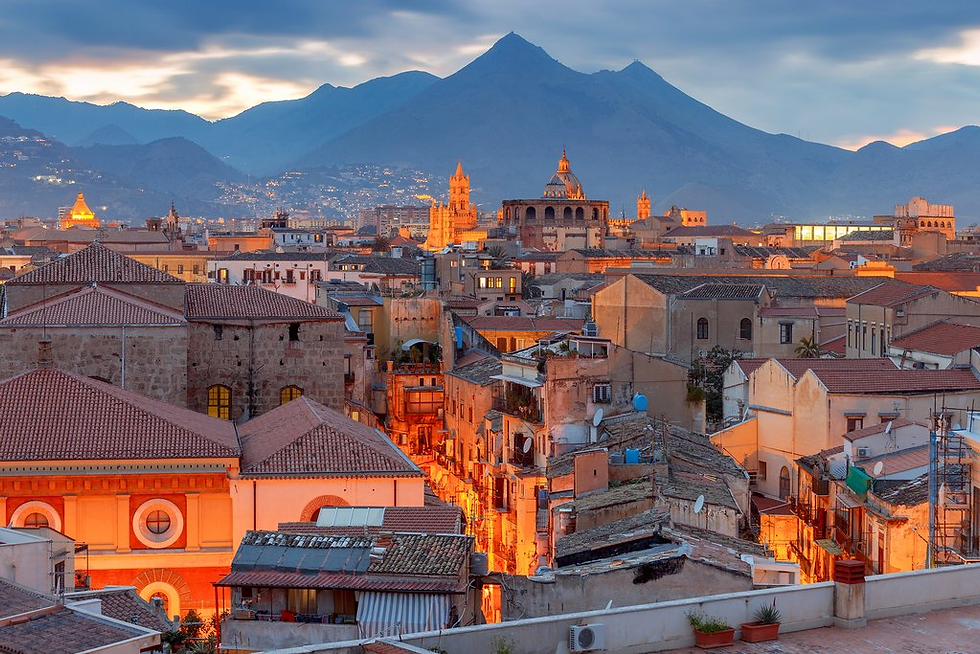
Since then Palermo has remained one of the Mediterranean’s great crossroads. After the Romans came the Byzantines, Arabs, Normans and Spanish rulers, each leaving their mark on the city’s language, architecture and culture. During the Arab period especially, Palermo became one of the wealthiest cities in Europe, famous for its gardens, citrus fruits, silk production and busy markets trading with North Africa, the Middle East and mainland Europe. Norman rulers later transformed it into a cosmopolitan royal capital where Latin, Greek and Arabic cultures mixed together. Even today, Palermo’s streets, churches, palaces and food still reflect centuries of Mediterranean trade, conquest and cultural exchange.
Today the city still operates in this capacity, with it bringing in millions of tourists every year. The area is also heavily influenced by the Sicilian Mafia but, as far as I can tell, the football team has kept its nose clean and not indulged in anything to break the letter or spirit of the competition.
So there you have it... Plamero. Strategic hub. City of trade, wine and defiance - a team built by English sailors and local dockers and supported by the very biggest of characters from the game's early history. And today, part of a stable of teams that are looking to dominate the world.

*Lipton was born into poverty in Glasgow but worked his way up to become a great tea merchant (hence the Lipton brand...). He also loved his sailing and his football. He helped kick-start a swathe of teams in Latin America and Italy - the first ever international cup was the Lipton Trophy - won by Argentina who beat rivals Uruguay. He also arranged some of the first European domestic games - which is where West Auckland FC became famous - they won the cup. Anywho - in terms of Palermo his yacht, The Erin, was in harbour as the original team was looking for someone to play. Both Lipton and Whitaker sat side by side as they watched the yacht's crew play the Palermo side - sporting their pink and black for the first time.
Enjoyed discovering the history behind this badge? This story also appears in Wolsey Academy's Renaissance History curriculum, where students explore the people, places, ideas and events that shaped the Renaissance through enquiry-based lessons, projects and historical investigations.
Teachers can browse the full collection at www.wolseyacademy.com/shop and receive 50% off any lesson bundle using the exclusive #GetTheBadgeIn code GTBI50.


Comments