


Norwich City FC

Alright. Here we go. The one I’ve been dreading.
Dreading because I’m an Ipswich fan – and as much as I wish nothing but ill fortune on my fellow East Anglian team – I must begrudgingly admit that their badge and city history is probably one of the finest around. Long ago, the North Folk and South Folk used to be united under several different flags and kingdoms – so I suppose I can take solace in that their history is also one shared by all of the East Angles – and that includes me!
So, let’s get on with it then, and #GetTheBadgeIn
The story of Norwich begins long before football. The area was first settled by the Iceni tribe, whose lands were later taken over by the Romans. After their departure, Anglo-Saxon settlers built a town along the River Wensum, calling it “Northwic”, meaning a northern trading place (Ipswich was similarly named – as a trading post on the River Gipping – you also have Harwich and Greenwich). By the time of the Viking raids and the rule of King Æthelstan in the 10th century, Norwich had become a busy and important centre of trade, with its own mint producing coins used across Europe.

Everything changed after the Norman Conquest. The Normans reshaped the city completely, building Norwich Castle initially as a motte and bailey (a sort of IKEA quick-assembly castle using local timber and earth) and then shortly afterwards upgrading it into a huge stone fortress overlooking the settlement. The keep, still standing today, would have dominated the skyline and reminded everyone who was in charge (recent digs have discovered that the Normans built atop a large Saxon burial ground – just to rub salt in the wound).

During the Middle Ages, Norwich grew into one of the richest and largest cities in England, second only to London at times. Its wealth came from wool. The surrounding countryside produced huge amounts of it, and Norwich became a centre for weaving and trade, linking it to markets across Europe. This prosperity funded the building of dozens of churches, guild halls, and fine houses, many of which still survive today. Walk through Norwich now, along streets like Elm Hill or Tombland, and you are walking through a city that still carries its medieval past almost intact. And as a Suffolk boy, I have to admit, it is a beautiful city to visit.
With that importance came symbolism. The lion, taken from the royal arms of England, became part of Norwich’s identity, representing strength, authority, and its connection to the Crown. Early versions of the city’s coat of arms combined the lion with the castle, tying together royal power and local pride. This imagery fed directly into the football club’s crest, with the lion and castle in the top left corner.
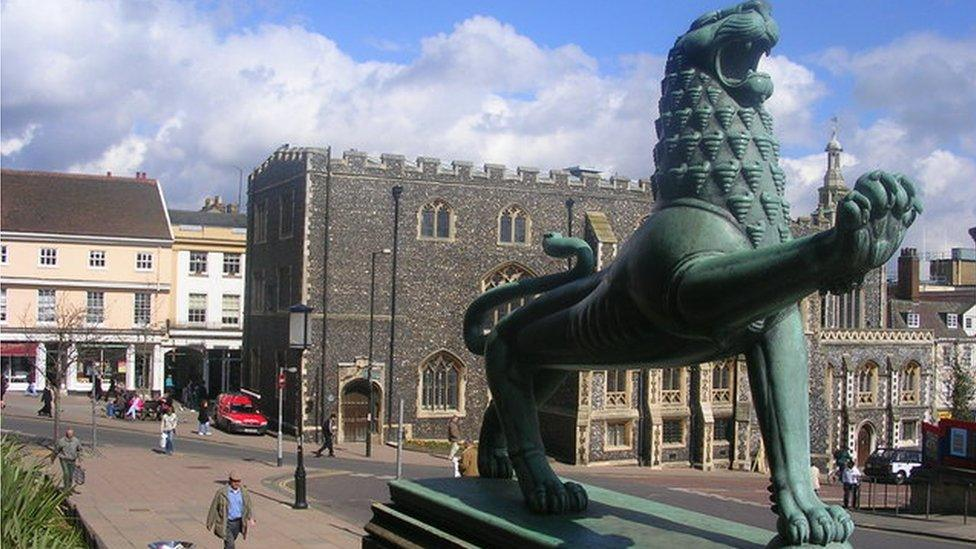
That connection to the lion can still be seen across the city today, from the bronze lions guarding City Hall to the long-standing Jarrolds department store, whose own lion emblem reflects that heritage.
And yet, for all this history of power and wealth, Norwich’s football identity is clearly linked to an altogether different symbol: the canary (or budgie, if you’re a Town fan).

The story goes back to the 16th century, when Dutch and Flemish refugees, known locally as “The Strangers”, arrived in Norwich after fleeing religious persecution in Europe. They played a huge role in reviving the city’s textile industry, bringing new skills, ideas, and connections to trade. Their influence was so significant that their name still echoes through the city today, appearing in societies, community groups, and coffee shops – a lasting reminder of how deeply they shaped Norwich life.
But they also brought something smaller, and perhaps more lasting.
They brought canaries. I’m not entirely sure why, to be honest. These small yellow birds, originally linked to the Canary Islands, were kept as caged birds and bred in large numbers. I am assuming that they were an exotic sideline business for the weavers. In Norwich, they became associated with the Flemish marketplace in the centre of the city, where their singing would fill the air as people worked and traded. Over time, the city became famous for them.
By the late 19th and early 20th century, Norwich was exporting canaries across the world. Local breeds such as the “Norwich plain head” and “Norwich crest” were in high demand, with thousands sent overseas, even across the Atlantic. Entire communities formed around the trade, with bird societies based in pubs across the city. For a time, Norwich was not just a place that kept canaries; it was a place defined by them.
When Norwich City F.C. was formed, this identity slowly transferred to football. The club was originally known as “The Citizens” and played in blue and white (proper colours), but by 1905 the name “Canaries” had started to appear. There is some evidence to suggest that it was an early FA Cup tie against West Bromwich Albion (nicknamed “The Throstles” after the bird on their crest) that led some national media to refer to the game as a bird-singing contest against the Norwich Canaries. The name stuck. By the 1907–08 season, when the club adopted the now-famous yellow and green colours, the transformation was complete.
The canary trade itself, along with most of Norwich, suffered a huge setback in the Great Flood of 1912. It is the worst recorded in the city’s history and was caused by over seven inches of rainfall in 24 hours combined with high tides. The disaster saw the River Wensum rise 16.5 feet, leaving thousands homeless, damaging roughly 15,000 properties, destroying over 40 bridges, and isolating the city. While the city recovered, the canary trade never did to the same extent.
Today, however, the canary is everywhere. It sits proudly on the club badge, appears in pub names and businesses, and remains one of the most recognisable identities in English football.
So there you have it. A trading settlement, a Norman stronghold, a medieval powerhouse, a place shaped by migration and industry. Its badge tells that story in miniature: the castle for its past, the lion for its power, and the canary, small but unmistakable, for the migrants who shaped it.
Norwich will always be Canary yellow. 🐤
And I will always (begrudgingly) admit that, for all that they lack in football trophies, they do have a proud and brilliant local history.


Great write up.
While various figures in the club's early history were involved in the nickname's adoption, Jon Bowman (Manager between 1905-1907) is often credited with helping popularise it.
Around 1905, he reportedly began referring to his players as his "Little Canaries" because of the city's long-standing connection to bird breeding. This informal term caught on with fans and local media leading to its official adoption.