


Kidderminster Harriers FC

Yesterday, the Kidderminster Harriers F.C. won promotion to the National League, defeating South Shields F.C. 2-0 and moving back up the pyramid.

The Harriers have enjoyed success in their past as an established EFL side, with a highest-ever finish of 10th in League Two in 2002. They have also built up quite a trophy cabinet, including an FA Trophy win and a remarkable 27 Worcestershire Senior Cups. The team have spent their entire history playing at Aggborough Stadium, a very neat-looking ground which seats around 7,000 and frankly looks far too tidy for National League North.

Along with a strong ground, they are also an incredibly strong brand. Growing up as a kid listening to the day’s football results coming in, they were always a name that stood out. Despite being formed in 1886, they almost sound like an American-style franchise team. “Harriers” certainly catches the ear amongst the endless sea of Uniteds, Citys, and Rovers that make up much of English football.
So, let’s #GetTheBadgeIn and see what lies behind the name.
The Harriers. If you have heard the term before, it is probably connected not to football clubs, but to running and athletics clubs. And that is exactly where Kidderminster’s name comes from.
The club was initially formed out of a local running club, itself founded in 1877, before merging with the local rugby club to create “Kidderminster Harriers and Football Club” — with rugby commonly referred to simply as “football” at the time. In 1886, the club switched codes and adopted Association Football instead.
But why “Harriers” in the first place?

To understand that, you need to know about the Victorian-era craze for “hare and hounds” clubs. These clubs, the first of which was the Thames Hare and Hounds Club in 1868 (pictured), were based around a cross-country chasing game that later evolved into organised cross-country running. Beginning in public schools such as Repton before spreading across the country, they became hugely popular with young people.
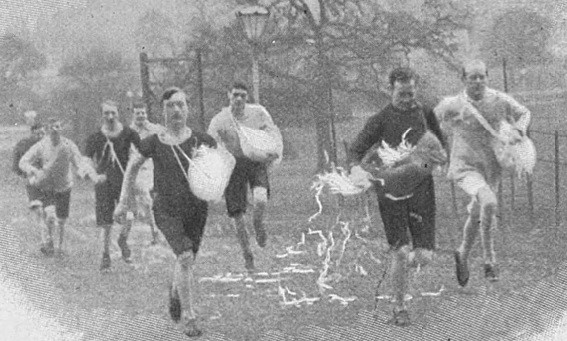
In these events, one or more runners, known as the “hares”, would set off first and leave a trail of paper scraps — hence the alternative name “paperchase” — across the countryside. The remaining runners, known as the “hounds”, followed later and attempted to track and catch them. The activity was part sport, part outdoor adventure, and part social gathering. It developed endurance, navigation, teamwork, and fitness, and probably sounds a lot healthier than sitting indoors for days scrolling social media or playing Roblox, as much of today’s youth seem inclined to do.
Over time, the chasing aspect faded and the sport gradually developed into modern cross-country running. The term “harrier” became closely associated with runners covering rough terrain in pursuit of a trail, which is why clubs such as Kidderminster Harriers F.C. inherited the name.

And from there, the badge almost designs itself. A marsh harrier, one of Britain’s largest birds of prey, creates a distinctive “V” shape with its wings as it swoops down on prey, making it a fitting symbol for a football club.
Kidderminster itself, situated south-west of Birmingham, has roots stretching back to Anglo-Saxon times. It grew into a major centre for cloth-making, benefitting from its position at a crossroads between larger settlements, its proximity to the River Severn where cloth could be washed, and the sheep-producing areas nearby that supplied wool.

Over the centuries, this specialisation received further boosts from skilled French Huguenot migrants — many of whom also settled across East Anglia — followed by the opening of the Staffordshire and Worcestershire Canal and later the railway in 1852. One of the Harriers’ other nicknames was “The Carpetmen”, owing to the town’s expertise in carpet weaving. By 1951, more than thirty carpet manufacturers operated in the town, employing over 15,000 people. The local newspaper is still called The Shuttle, named after the shuttles used on carpet looms.
Sadly, the local carpet museum, which helped preserve this tradition, closed last year due to financial difficulties. Hopefully, it can be revived soon, because losing something like that feels like a senseless and rather tragic blow to local history and culture.
Yet, let's look on the bright side. Their football team is now sweeping back up the league - and with it will come a handful of extra fans each week as Kidderminster again can host some of the larger names in English football. The town will benefit - and maybe some of the visitors will stop to take an interest in the local
There is more in Kidderminster's history left to weave.


Comments