


Hartlepool United FC
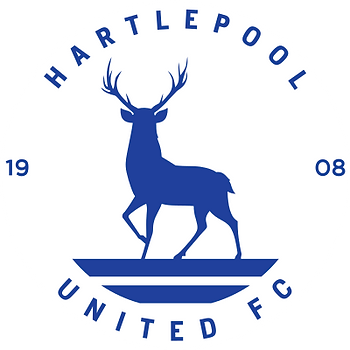
Hartlepool United. The Monkey Hangers. A club that wears its legend on its sleeve and its town’s history in its badge. From shipyards and steelworks to siege and folklore, this is a place — and a team — that has been through it all. So, let’s #GetTheBadgeIn.
Founded in 1908 as Hartlepools United Football & Athletic Club Company Ltd, the club took its early identity from West Hartlepool, who’d won the FA Amateur Cup in 1905 before dissolving in 1910. The new club took on their assets, debts, and place in the North Eastern League. In 1921 they joined the Football League’s Third Division North and for the next 37 years made it their home before landing in the newly formed Fourth Division.
In 1968, the name changed to simply Hartlepool after the towns of West Hartlepool, Hartlepool, and the village of Hart were merged. They became Hartlepool United in 1977. Promotions came in 1967–68, 1990–91, 2002–03, and 2006–07, though each was followed by relegation. The club’s longest Football League stay ended in 2017 after 96 years, but promotion back was sealed in 2021 after beating Torquay in a the National League play-off final. Sadly, they dropped back again in 2023.
If Hartlepool’s football history is a tale of resilience, the town’s story is even more dramatic. Perched on a headland in County Durham, the old town was founded in the 7th century around a monastery led by St Hilda. Bede himself described it as “the place where deer come to drink”. The name comes from the Old English heort (hart) and pōl (pool). In the Middle Ages, Hartlepool’s harbour became the County Palatine of Durham’s official port.
The 19th century brought transformation. With coal from the Durham fields and shipyards along the docks, Hartlepool’s fortunes boomed. Ralph Ward Jackson’s creation of West Hartlepool in the mid-1800s saw the area grow into a shipbuilding powerhouse. By 1913, 43 ship-owning companies were based here. But its importance also came with risk. On 16 December 1914, the Imperial German Navy shelled the town with 1,150 shells, killing 117 people. Hartlepudlians responded in typical style — by raising more money per head for the war effort than any other town in Britain.
Folklore, though, is what gives Hartlepool its most famous nickname. During the Napoleonic Wars, legend has it a French ship was wrecked off the coast. The only survivor was a monkey in a French uniform. Locals, having never seen either before, decided the monkey must be a French spy. A “trial” was held, the monkey could not answer, and it was hanged on the beach. Today, a monument to the monkey stands on the shore, and Hartlepool United lean into it with H’Angus the Monkey as their mascot. One wearer of the costume, Stuart Drummond, even became the town’s mayor in 2002. The only town I am aware of to vote for a monkey.
The club’s badge and colours connect to this wider story. Hartlepool have played in blue and white stripes since 1912, with occasional experiments in all-blue or light-blue kits. The badge has shifted from simple initials to versions featuring the hart from the town’s crest, to a 1995 design with a ship’s wheel — a nod to the maritime heritage — and back again to a hart standing in water in 2017.
That maritime link is everywhere in Hartlepool. The National Museum of the Royal Navy sits in the redeveloped docks, home to HMS Trincomalee, the oldest British warship still afloat. Built in Bombay in 1817, she travelled the world on policing and protection duties before retiring here. Shipwrights and conservators now work daily to keep her in shape. Cannons fire on weekends - keeping the memory alive with a boom.
Like the town, Hartlepool United have had their share of battles. Between 1924 and 1984, they had to apply for re-election to the Football League 14 times — a record. They stayed up every time, often scraping survival on the last day. Brian Clough began his managerial career here, Ritchie Humphreys racked up a record 543 appearances, and Joshie Fletcher’s 111 goals remain the club’s best.
Industry’s decline hit the area hard in the late 20th century. British Steel’s closure in 1977 cost 1,500 jobs, and unemployment soared to 30% in the 1980s. The docks’ redevelopment into a marina in the 1990s, followed by the Historic Quay and HMS Trincomalee’s restoration, marked the start of a fightback.
Yet the club has always been more than results. Hartlepool United are a focal point for a community that’s endured bombardment, industrial collapse, and the long grind of lower-league football. Their badge, whether ship’s wheel or hart in the water, tells you exactly who they are: a town and team shaped by the sea, defined by hard work, and unafraid of the odd scrap — whether that’s in the boardroom, on the pitch, or with a shipwrecked monkey.


Comments