


Chelmsford City FC
- Jun 15, 2025
- 3 min read
In the heart of Essex sits its county town of Chelmsford (@OfficialClarets). Despite its size, economic strength, outstanding schools, and cultural institutions, Chelmsford has long been overshadowed in football by its Essex neighbours, Colchester and Southend, and even rivals Braintree, who currently play a league above them. Situated within London’s commuter belt, Chelmsford faces the challenge of losing support to the allure of London’s football giants. Nevertheless, they are a popular second team for many and deserve a much higher place in the footballing pyramid. They currently sit 15th in the National League South.
With Southend and Colchester struggling, the title of Essex’s footballing crown is up for grabs. Could Chelmsford City finally step out of the shadows and claim it? Unlike most clubs, which emerged from bored cricketers in winter, Chelmsford was founded in 1878 by the city’s ‘Lawn Tennis and Croquet Club,’ - very fancy. In 1938, they turned professional, and their inaugural FA Cup run saw them beat Southampton 4–1 before bowing out to Birmingham City.
Chelmsford has been a consistent non-league contender, most famously participating in the Anglo-Italian Cup in the 1970s and 1980s, facing clubs like Cremonese and Bari. With non-league football gaining attention thanks to Ryan Reynold’s Wrexham and a lucrative DAZN deal, perhaps it’s time to bring back the Anglo-Italian Cup? An Easy Jet flight for the squad would probably be cheaper than a cross-country coach trip and I’m sure it would draw patriotic crowds.
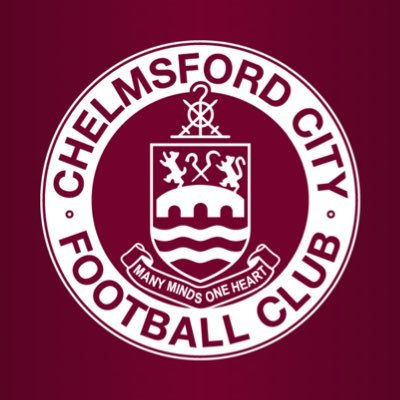
So, let’s #GetTheBadgeIn. The football club’s badge is based on the city’s old coat of arms. While an updated version was granted in 1975, the original from 1889 remains its foundation.
At the top, the badge features a circle with a bishop’s staff (crosier) and crossed swords. The circle, originally a ring of oak leaves, symbolises the civic authority of Chelmsford’s role as Essex’s county town since 1218. The swords represent the Bishop of London, who in the 1100s rebuilt a Roman-era bridge over the River Can.
This bridge was a significant step and is also the main focal point of the badge (complete with the waves of the river underneath). Nearly 600 years after the Romans left Britain, the Normans revived this vital trade route to East Anglia. The badge also symbolises Chelmsford’s role as a gateway from London to the East of England—a role it still plays today, as anyone stuck at the station during a signal failure can confirm!
The two crossed crosiers represent the Bishop of London, who held the Manor of Chelmsford, and the Abbot of Westminster, who held the Manor of Moulsham. At this time, England’s churches and monasteries wielded enormous power, collectively controlling over 50% of the country’s land. Rents paid from Chelmsford and Moulsham funded these institutions, enabling the construction of England’s breathtaking churches and cathedrals (like Chelmsford’s own)— these medieval mega-projects sprouted from the land on the backs of the peasant farmers’ graft.
The badge also tells the story of Henry VIII’s break with Rome. The two lions flanking the crosiers are symbols of the Mildmay family (who have three upright lions on their shield), who were granted Moulsham Manor after it was confiscated from the Church. Thomas Mildmay, a loyal servant of the Tudors was made ‘Auditor of the Court of Augmentations’, which was the fancy name for the group that oversaw the redistribution of Church lands. Having thought long and hard about the best way to do it, Mildmay conveniently awarded himself the manor.
There’s an interesting parallel here with Hornchurch to the south, whose FC badge features red roses linked to William de Wykeham, another Tudor official involved in redistributing Church lands to themselves. Also, both Mildmay in Chelmsford and Wykeham in Hornchurch used their newfound wealth to establish colleges at Cambridge University—Wykeham founded New College, while Sir Walter Mildmay, Thomas’s son, founded Emmanuel College.
The modern University team should play Chelmsford in a friendly each year for a ‘Mildmay Medal’… just a thought.
So, there we have it. Initially, I thought this badge, which was largely tied to religious orders, would make for a boring story. Instead, what you have is one that showcases the importance of trade to the nation (and infrastructure to facilitate it) and the transfer of power from Church to State. There could be little more English than this.
Back in the 1970s, when non-league teams were sent to Italy to compete, sending Chelmsford, who’s badge tells the story of the seizure of Rome’s authority, could hardly have been more fitting.
Let’s send them again.


Comments