


Celta Vigo - Away Kit 24/25

I really like this kit. I also love the Celta Vigo badge – and I write a long blog post deconstructing its exceptional history here:
So I intend for this one to be a little shorter. So let’s drive straight in!
On the back of the shirt is the Trisquel logo. This three-armed fan-looking emblem is another ancient symbol of the Celts and it appears in many of their designs. It is perhaps most famous today on the flag of the Isle of Man with its three running legs. But the Trisquel has also appeared on the back of Celta Vigo shirts in recent seasons, neatly linking the club to the Celtic heritage that inspired the name “Celta” in the first place.

The main feature of this away shirt, however, sits across the shoulders. Look closely and you will see a skyline graphic showing five landmarks from the city of Vigo itself. It is a nice touch. A football shirt that literally carries the city on its shoulders.
Let’s have a look at them.

The first is the Rande Bridge. This huge cable-stayed bridge stretches across the narrowest point of the Ría de Vigo and opened in 1978 as part of the Atlantic motorway network. Before the bridge existed, travel around the estuary could take a long detour inland or required boats and ferries. The bridge changed all that and helped connect Vigo more closely to the rest of Galicia. But the water below it carries a story that goes much further back. In 1702 this stretch of water was the site of the Battle of Vigo Bay, when an Anglo-Dutch fleet attacked a Spanish treasure fleet sheltering in the harbour during the War of the Spanish Succession. The bridge therefore sits above one of the most famous naval battle sites in Spanish history.
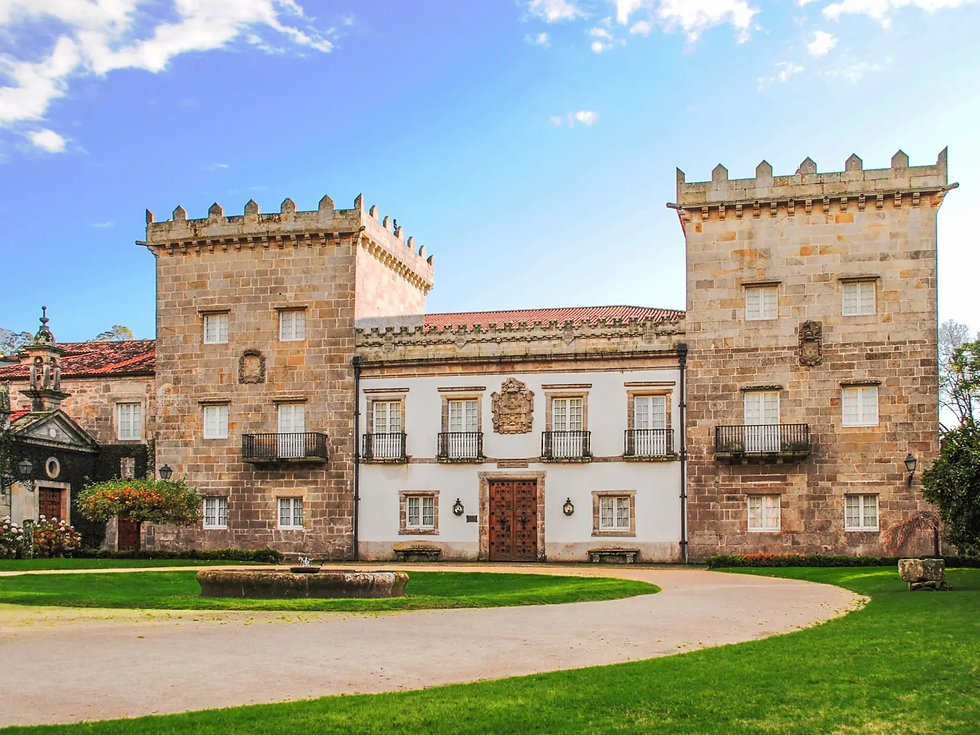
Next comes the Pazo Quiñones de León, located inside the beautiful park of Castrelos. A pazo is a traditional Galician manor house, and this one dates mainly from the seventeenth century. It belonged to the noble Quiñones de León family before eventually being given to the city in the early twentieth century. Today the building houses the Municipal Museum of Vigo, while the surrounding estate has become the city’s largest park. It is a lovely example of how old aristocratic estates were transformed into public cultural spaces. If the Rande Bridge represents modern Vigo and its connections, Castrelos represents its history and culture.

Then there is the Alcabre lighthouse, standing along the Atlantic coastline near the neighbourhood of the same name. Vigo has always been a maritime city. Fishing fleets, merchant vessels and naval ships have all passed through this estuary for centuries. The Galician coast can be rough, foggy and unforgiving, so reliable navigation has always been essential. Lighthouses like the one at Alcabre helped guide ships safely into the harbour, particularly at night or in poor weather. It is therefore a fitting reminder that Vigo’s identity has always been tied to the Atlantic Ocean.

The fourth landmark is the Chapel of A Guía, perched high on Monte da Guía overlooking the harbour. The chapel dates back to the sixteenth century and was dedicated to the Virgin Mary as a protector and guide for sailors. Its elevated position meant it was visible from the sea, serving both as a religious symbol and a helpful landmark for ships approaching the harbour. Today the hill is one of the best viewpoints in the city. From the top you can see the harbour, the estuary and the Atlantic beyond. It is easy to imagine generations of sailors looking up at that hill as they returned home.

Finally we come to the Berbés arcades, perhaps the most historic of the landmarks on the shirt. Located in the old district of O Berbés, these stone arches date mainly from the seventeenth and eighteenth centuries and were once right on the waterfront. The buildings above the arches housed fishermen and traders, while the covered spaces below were used to unload and sell the daily catch. Markets and maritime life unfolded directly beneath those arches. Over time the harbour expanded and the shoreline changed, but the arcades remain as one of the few surviving reminders of Vigo’s origins as a small Atlantic fishing settlement.
And that is what I like about this shirt. It does not shout about trophies or sponsors or modern branding. Instead it tells the story of the city itself – its harbour, its sea routes, its historic estates, its fishermen and its views across the Atlantic.
Five landmarks. One skyline. One city on the shoulders of its team.
A very nice touch indeed.


Comments