


Bishop's Cleeve F.C.

In one of the most picturesque corners of England lies a village of 14,000 people represented by a football team known as the Mitres, with modest local success but bags – or perhaps hatfuls – of personality. They currently sit in Southern League Division One South and are knocking on the door of the Premier Division above. They narrowly lost in the play-offs last season and finished sixth this season. Another big push next year could get them into the seventh tier of English football, just one step away from National League South and the exposure that would bring.
There is one main story to tell here. The mitre. The bishop's hat. But it is so much more than that.
So let's pay the Mitres the respect they deserve and #GetTheBadgeIn.
Let's start with the name – Bishop's Cleeve. "Cleeve" is derived from the Old English clif, meaning cliff, and was first recorded nearly 1,200 years ago.
A cliff because the settlement sits at the foot of a number of large hills and escarpments, all part of the wider Cotswold Escarpment – a limestone ridge that has historically helped separate England and Wales. Cleeve Hill and Nottingham Hill both offer excellent views across the Severn Valley and into nearby Wales.
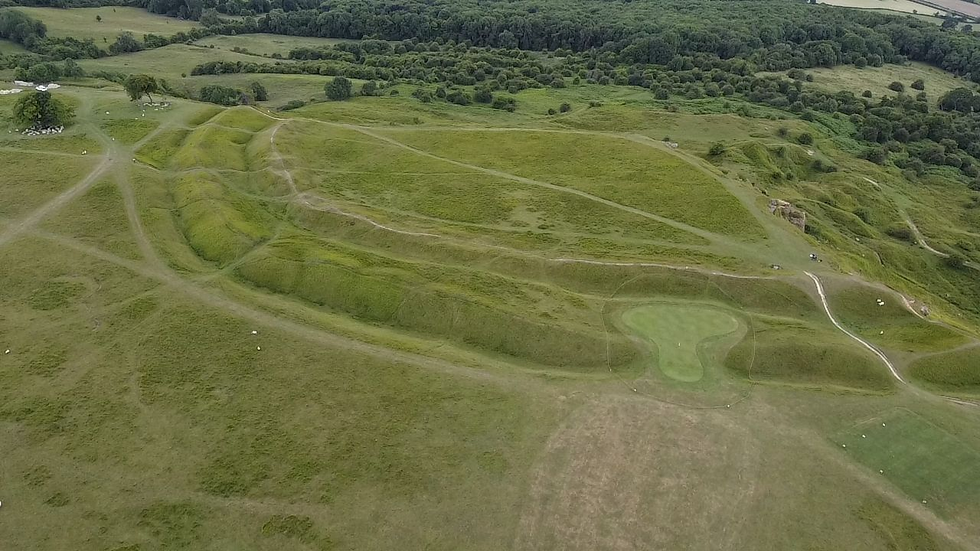
Its natural defensive features were not lost on the Iron Age Britons 2,500 years ago. At the summit of Nottingham Hill sits The Camp, one of the country's largest Iron Age hill forts.
It spans around 120 acres and, in its heyday, comprised several rows of earthworks topped with timber palisades. Inside stood roundhouses alongside storage pits for grain and livestock enclosures. Access to the site would have been funnelled through a narrow entrance easily overlooked by the defenders.
Today the local golf course has been built into one corner of its remains... clearly the locals still appreciate a good bunker... (...I'm quite proud of that).
Its importance was recognised by the Romans when they arrived, and they built a fortification nearby. When the Saxons came, they established the village at the base of the cliff, and they were the first to record its name.
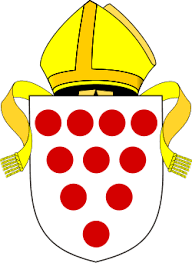
In the ninth century it gained the title "Bishop's" as the land fell under the control of the Bishop of Worcester, and with that came the bishop's mitre that adorns the club's badge today. The Bishops' badge has the mitre on top and ten red spots which come from the family crest of Godfrey Giffard, an influential medieval Bishop of Worcester whose heraldic symbols were later adopted by the diocese. The red circles were originally a family emblem but later came to be associated with the Ten Commandments in Christian tradition.
So, on that note, let's talk church for a bit and explain exactly what this means.
The Diocese of Worcester encompasses 169 parishes, including Bishop's Cleeve. It was established during the Anglo-Saxon period around 680 CE. While the internal structure of the Church may be enough to bore most modern people, it was exceptionally important for most of its history.
The Church wasn't just an old building you visited occasionally for a funeral. It was the region's largest landowner and employer. Local peasants would often have been required to work at least one day a week – sometimes more – on church-owned land for free. The produce grown was then taken to the local tithe barn, with the tithe being a compulsory annual payment made to the Church.

Today, that tithe barn, with its beautiful timber ceilings and stonework, hosts weddings and Zumba classes. For most of its history, however, it housed the surplus produce from church lands before it was sold, generating considerable wealth for the Church.
Failure to work on church lands or pay the tithe could result in a one-way ticket to hell – or so people were told. The Church reinforced this message through sermons, stained-glass windows and paintings depicting the fiery eternity awaiting anyone who neglected their duties.
Not a bad little business model.
It ensured that the Church remained at the centre of economic and political power for centuries. Indeed, it was the exploitation of this system by Rome that contributed to England's first great "Brexit". The Bishopric of Worcester, for example, was at times held by absentee Italian bishops who never set foot in England but nevertheless collected the income it generated.
In that environment, I suspect even I, an ardent pro-European, would have found myself siding with the Brexiters of the day, demanding that England leave this rotten system and forge a new direction – and a new religion – of its own.

The Church of England was born during the English Reformation of the 1530s, helped in no small part by Henry VIII's determination to marry Anne Boleyn and his frustration at the Pope's refusal to grant him a divorce.
The Bishopric of Worcester subsequently fell to a man named John Hooper, a native of nearby Gloucester. As a young man he embraced the new ideas of Protestantism and travelled across Europe to learn from its leading thinkers. He returned only once England had begun to follow a similar path.
He was appointed bishop and quickly set about reforming the diocese. During an early inspection, he discovered that of the 311 clergy under his authority, 168 could not recite the Ten Commandments.
By all accounts, he was a good bishop. He sent the profits of the bishopric to the Crown and lived modestly. He also married – something Catholic bishops were not permitted to do. Furthermore, he wrote to the King's advisers expressing concern about rising living costs and the hardship they were causing the poor.

However, all of this changed with the accession of Mary I, Henry VIII's Catholic daughter. She slammed the country's religious reforms into reverse, and radicals like Hooper quickly found themselves in her sights. He was removed from office, imprisoned for his Protestant beliefs and eventually burned at the stake. Because it was an extremely cold and windy February morning, the wood used for the pyre failed to catch fire properly. The fire had to be relit multiple times, making the execution a drawn out and agonising ordeal. The site today in Gloucester marked with a monument to this 'martyr'.
He was one of around 300 Protestants executed during Mary's reign, earning her the nickname "Bloody Mary" – a reputation preserved by generations of Protestant historians, who were perhaps less eager to discuss the even greater number of deaths associated with rulers such as Henry VIII and Elizabeth I.
Today, Bishop's Cleeve is a much more peaceful place, with little religious tension in the air.
The only thing in the air nowadays is the modern aerospace industry. The nearby industrial estate hosts a small but significant cluster of aviation companies, including the American giant General Electric.

From its base in Bishop's Cleeve, GE helps maintain Emirates' vast fleet of Boeing 777 aircraft. The company is responsible for electrical systems that keep these workhorses of the modern world airborne and safe.
So there you have it.
Bishop's Cleeve take quite a story onto the pitch every Saturday – from Iron Age fort builders to religious reformers to aerospace engineers.


Comments