


AFC Sudbury
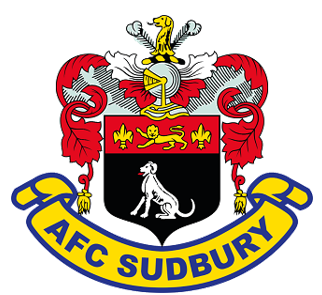
Staying in East Anglia, we look this time at @AFCSudbury for a tale of trade, migration, bishops, and painters – as we #GetTheBadgeIn for AFC Sudbury.
AFC Sudbury are on a roll, having had a cracker of a weekend, putting 3 past Stratford Town without reply in their Premier Division Central match. Football in Sudbury was long dominated by two teams: Sudbury Town (managed by Charlie Hurt, father of Geoff Hurt) and Sudbury Wanderers. They merged in 1999 to form AFC (Amalgamated Football Club) Sudbury and now play in the 7th tier of English football. Promotion would see them move up to National League North, with hopes of eventually reaching the National League (formerly the ‘Conference’).
The club's badge, adapted from the Sudbury Town coat of arms, reveals much about the area’s history. The red shield features two French fleur-de-lys and a lion, symbolising the town's royal status. Since William the Conqueror, Sudbury has been important to the monarchy, largely due to the wealth from its market, established in 1009, at the heart of East Anglia’s wool trade. Wool, once England’s most valuable export, funded Sudbury’s grand churches. Its significance led to part of the River Stour being diverted to give the town additional protection.
In 1352 Edward III invited skilled Flemish weavers to Sudbury, boosting the economy further. The original ‘woolsack’ in the House of Lords (essentially a big red beanbag) was made with Sudbury wool, acknowledging its importance.
The badge's standout icon is the Talbot dog, related to bloodhounds it was brought to England by William the Conqueror, but it is now an extinct breed. The Talbot features on Sudbury’s crest via the Theobald family, a powerful local cloth-trading dynasty. Simon Theobald (Simon of Sudbury), born in 1318, became Archbishop of Canterbury and Lord Chancellor (basically second in command of the country, after the King). He used his wealth to build a college for priests in Sudbury. His Coat of Arms – the Talbot dog with its tongue sticking out – is carved into the walls of Canterbury Cathedral too.
In 1381, Simon’s support for Richard II’s Poll Tax—funding the Hundred Years’ War—sparked the Peasants’ Revolt. Angry mobs stormed London, burning noble homes and targeting Simon, who had taken refuge in the Tower of London. Betrayed by guards, Simon was dragged out and decapitated, his head displayed on London Bridge. It now rests in St Gregory’s Church in Sudbury, attracting ghost hunters who claim to have seen him roaming the grounds.
Sudbury was also the hometown for painter Thomas Gainsborough, who in turn inspired the other famous Painter from the Stour Valley, John Constable. During the Second World War the town also became home to the 486th US Air Force Bomber Group.
So then, a royal possession, a powerhouse of the medieval economy, home to Europe’s best weavers and the haunting ground of a ‘properly headless Simon’ – not a bad legacy for a badge.


Comments