


Purdue Boilermakers

Purdue University, tucked away in West Lafayette, Indiana — about one hour north of Indianapolis and two hours south of Chicago — boasts one of the best sporting names in the game. Comprising one of the original ‘Big Ten’ college teams, they are, of course, the Purdue Boilermakers.
Like a lot of great nicknames, “Boilermakers” was originally an insult. After a brutal defeat to Wabash College in 1889, local newspapers and students described the Purdue players as oversized industrial workers — “blacksmiths”, “foundry hands”, “rail-splitters”, and eventually “burly boiler makers”. The students at Purdue embraced it, and today the Boilermakers are entrenched in local heritage and pride.
To understand the name, you need to understand that Purdue University was born during the great age of American expansion. The university emerged from the Morrill Land-Grant Acts, a programme designed to create practical universities focused on agriculture, engineering, mechanics, and science rather than purely classical education. America in the late 19th century was industrialising at astonishing speed. Railroads were stitching together a continental nation. Steel mills, foundries, machine shops, grain elevators, bridges, and locomotive works transformed the Midwest into the engine room of the United States — and the world.
Few inventions shaped American history more than the railroad. Before the railways, the United States was a collection of distant regions linked mainly by rivers and well-trodden tracks that would freeze or wash away in bad weather. Railroads unified the country economically and politically. They allowed Midwestern grain to reach eastern cities, coal and iron to fuel factories, cattle to move from the plains to Chicago slaughterhouses (hence the Chicago Bulls), and migrants to spread westward. Time zones themselves were standardised largely because rail companies needed reliable scheduling. Entire towns existed because tracks passed through them; others died when they did not.

The railroads also created a distinct American mythology. The locomotive became a symbol of progress, strength, noise, smoke, and unstoppable momentum. Industrial workers who forged boilers, riveted steel plates, and maintained engines became folk heroes of the machine age. The now controversial painting American Progress — showing European settlers advancing across the Great Plains of America, represented by Lady Liberty, with trains behind her and Native Americans scattering ahead of her — reflected this belief that trains built the modern USA.
To be called a “Boilermaker” in the 1890s, then, was a backhanded compliment for a football team — it suggested toughness and industrial masculinity. Purdue’s footballers looked less like refined scholars and more like men who had stepped directly out of a locomotive workshop.

What was the local connection between trains and Purdue then? To answer that, we have to look at the Monon Railroad. The Monon, opened in 1847 — formally the Chicago, Indianapolis and Louisville Railway — operated almost entirely inside Indiana and became woven into the identity of the state. Its lines linked Chicago, Indianapolis, Louisville, and the industrial towns between them. More importantly, it connected universities. Purdue, Wabash, Butler, Indiana University Bloomington, and DePauw University all sat along Monon routes. Student traffic was so important that the company painted rolling stock in university colours. Purdue’s black and gold eventually appeared on Monon locomotives themselves.
In Europe, universities were often medieval institutions tied to cathedrals or royal courts. In Indiana, they partnered with rail yards, engineering shops, and freight lines — sending their students to get hands-on experience in industry.
The Monon trains famously ran straight down the middle of streets in several Indiana towns. It developed its own unusual crossing signals where a green light stayed on permanently unless a train approached — drivers were warned to “STOP when signal is out”.
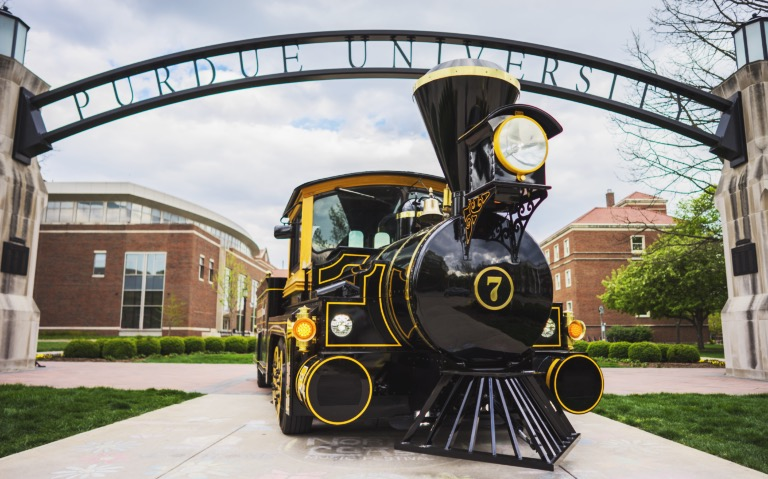
The university’s mascot reflects all of this history. Purdue’s official mascot, the Boilermaker Special, is a road-going locomotive styled after a 19th-century steam engine.
The name of the university itself lies with John Purdue. Purdue began as a high school teacher before buying land and entering the farming business. Rather than being a farmer, however, he turned his hand to becoming a broker between local farmers and buyers. He supplemented this business by opening a general store. He dabbled in all sorts of local investments — including part-funding a wooden toll bridge over a local river. When the American Civil War broke out, his ‘dry goods stores’ suddenly became essential suppliers to the Union Army and the profits began to roll in. Local Confederate sympathisers, however, began raiding his sites at night, so Purdue recruited a 100-strong regiment, known as the ‘Purdue Rifles’, to provide protection for his logistics operations.
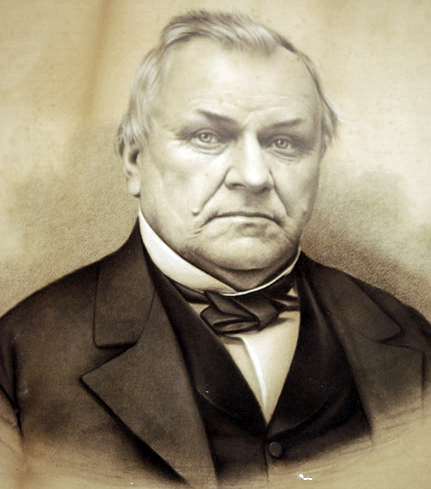
From the very beginning, Purdue was an active citizen, contributing to local good causes and initiatives. When a site for a new university under the Morrill Land-Grant Act was up for debate, a bidding war broke out to attract the new university to the local area. Purdue stepped up with $100,000 of his own money to bring the deal home — but only on the condition that the university bore his name.
It became one of the defining engineering institutions in the United States. Its practical focus perfectly matched the industrial economy around it. Purdue students did not merely study engineering in theory — they worked directly with machinery. Between 1891 and 1897, the university even maintained a fully operational steam locomotive for research and training. That fact alone probably helped people believe the legend that Purdue footballers were secretly railroad workers drafted in from nearby yards.

The colours of the Purdue Boilermakers — old gold and black — resemble coal dust, brass fittings, locomotive metalwork, and the grime of the machine age.
And that is really why the nickname has endured. “Boilermakers” does not simply refer to a football team. It represents an entire era of American history: railroads crossing the Midwest, engineering workshops roaring with noise, practical universities training industrial specialists, local philanthropists funding improvements, and the belief that technology and hard work could build a nation. They’re the best of America.

Comments